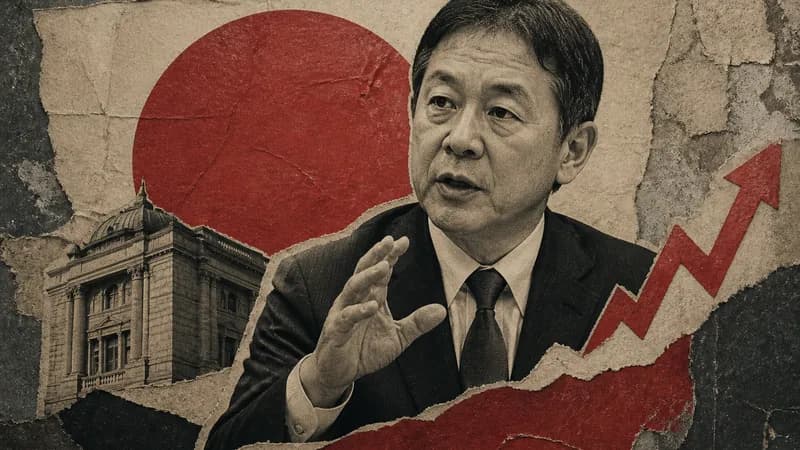
The Bank of Japan should raise interest rates as soon as possible if there are no clear signs of an economic slowdown, board member Kazuyuki Masu said in comments that appear to increase the chances of a June rate hike.
Masu, who voted to keep rates steady in April, may now join hawkish dissenters in calling for a rate hike at the BOJ's next meeting in June as surging oil costs from the Middle East war heighten inflationary pressures.
"I myself judge that the situation did not warrant a hasty hike," Masu said in a speech on Thursday. "That said, if data do not indicate clear signs of an economic downturn, I believe it is desirable to raise rates at the earliest stage possible."
The BOJ kept its policy rate steady at 0.75% last month, but three of the nine board members dissented and called instead for a hike to 1.0%, signaling growing alarm over inflationary pressures from the Iran war-driven energy shock.
A slew of recent hawkish signals from the BOJ have led markets to price in roughly a 70% chance of a rate hike in June. Nearly two-thirds of economists polled by Reuters before last month's meeting had also predicted a rate hike by June.
"While much depends on developments in the Middle East, the chance of Japan seeing clear data of an economic downturn before the BOJ's June meeting is small," said Yusuke Matsuo, senior market economist at Mizuho Securities. "There's a strong chance Masu will support a rate hike in June," he added.
Concern over inflationary risks pushed the yield on the benchmark 10-year Japanese government bond to a 29-year high of 2.625% on Thursday, as high fuel costs add to already building price pressures from the weak yen and steady wage gains.
While the shock from rising prices of fuel and chemical goods could prove temporary, Masu noted there was concern they could push up distribution costs and lead to enduring price pressures.
"As the behavior that took root during the period of deflation is now being unentrenched, Japan has clearly entered an inflationary phase," he said. "Therefore, what is vital from now on is to ensure that, through timely and appropriate policy rate hikes, the underlying inflation rate does not exceed 2%."
Masu said underlying inflation remained below 2% but was "drawing very close" to that level. He also stressed the need to be vigilant about the risk that the weak yen could accelerate price rises and heighten inflation expectations.
"Given that Japan's economy is no longer in a deflation, the BOJ must pull real interest rates out of negative territory as soon as possible," Masu said. He added that the BOJ needs to raise rates closer to levels deemed neutral to the economy, seen as somewhere in a range of 1.1% to 2.5%.
The BOJ exited a decade-long massive stimulus in 2024 and has raised its policy rate several times, including in December, on the view that Japan was on the cusp of durably achieving its 2% inflation target.
Soaring energy costs from the Middle East conflict have complicated the BOJ's rate decisions as they push up prices, but also hurt an economy heavily reliant on fuel imports.
Masu's hawkish tone turns the market's attention to speeches by Deputy Governor Ryozo Himino on Saturday, and by board member Junko Koeda on May 21. Both voted for keeping rates steady in April.