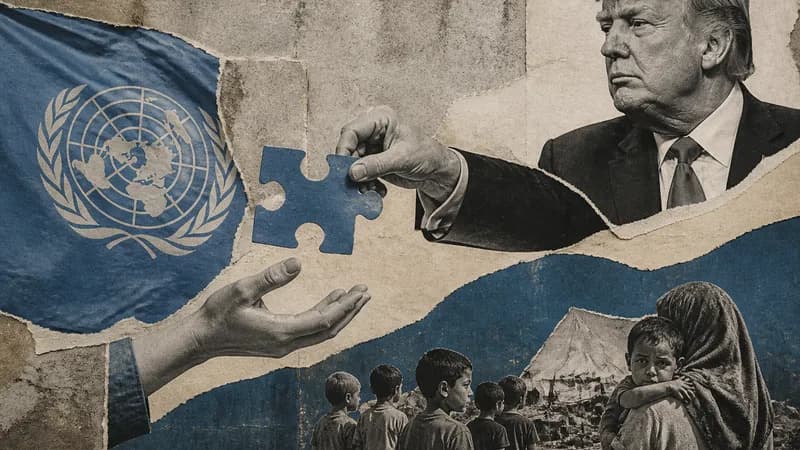
The State Department's top aid official said Thursday that $1.8 billion in new humanitarian aid provided by the U.S. through the United Nations would align with the Trump administration's foreign policy interests.
The new funding pledge adds to $2 billion announced in December under a new mechanism designed to make aid funding more efficient and increase accountability as developed nations slash aid spending.
Jeremy Lewin, a former staffer of Elon Musk's Department of Government Efficiency who has been performing the duties of undersecretary for foreign assistance, humanitarian affairs and religious freedom, said 92% of U.S. assistance via the mechanism had been "hyper-prioritized" on life-saving aid, and this would continue.
"Hyper-prioritized, focused and focused on the places where we have a foreign policy interest, where it aligns with the president's interest," he said, referring to U.S. President Donald Trump.
This meant funding from Washington, the largest single donor to the United Nations Office for the Coordination of Humanitarian Affairs (OCHA), would not go to certain countries where U.S. interests do not align with OCHA priorities, Lewin added, noting OCHA funding is not all U.S. humanitarian aid abroad.
"By avoiding those countries, we're not doing a disservice to the humanitarian sector," Lewin said. "We're allowing us to focus on the areas where we overlap, and we don't think that there needs to be some compromise in their principles ... while also allowing us the sovereign right to invest in places where it aligns with our national interest."
OCHA chief Tom Fletcher, speaking alongside Lewin, said the UN was retaining its principles of neutrality and impartiality while reforming its humanitarian system amid declining funding and 300 million people in need worldwide.
Before the latest U.S. announcement, OCHA had raised $7.38 billion from 65 member states toward its $23 billion goal for this year, Fletcher said.
Separately, Washington owes about $4 billion to the U.N., including $2.4 billion for current and past peacekeeping missions, $43.6 million for U.N. tribunals, and the rest to the regular budget.
U.S. Ambassador to the UN Mike Waltz said Thursday that in January the U.S. paid $159 million toward its regular budget arrears, "and we will have an additional substantial charge towards our regular budget coming soon."