


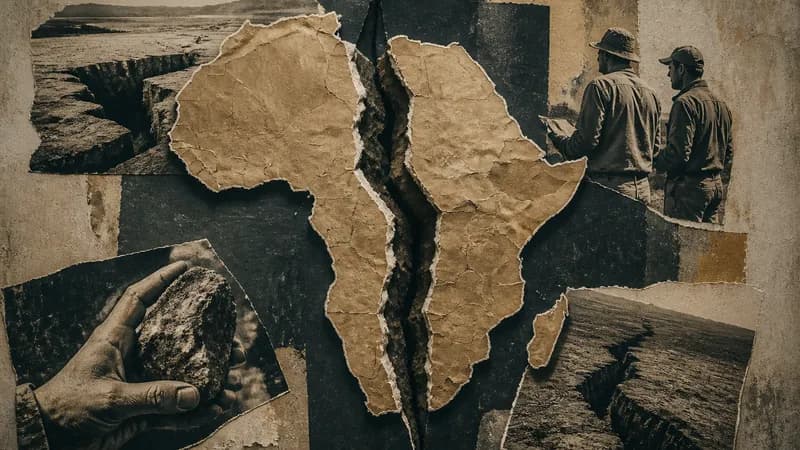
An international group of geologists has found evidence of a new crack forming in East Africa after analyzing gas samples from geothermal springs in Zambia's Kafue Rift Valley.
The study, published in the journal "Frontiers in Earth Science," suggests that this process could lead to the formation of a new lithospheric plate.
"This discovery has not only geological and tectonic but also economic significance. The formation of the crack will create easily accessible geothermal energy sources and boost the hydrogen and helium extraction industry," the article emphasizes.
Experts from the UK, Canada, Zambia, and France, led by Oxford University professor Michael Daly, studied the Kafue Rift Valley in central Zambia. This valley, located on the Central African Plateau, is rich in numerous previously unexplored geothermal springs.
The scientists used quadrupole mass spectrometers to comprehensively analyze fluid samples from eight hot springs. This experiment determined the concentration of gases in the water and the isotopic distribution of elements, revealing the depth at which the emissions formed.
The analysis showed that the spring waters in the Kafue Valley contain unexpectedly high levels of helium and other inert gases. Their isotopic composition matches the Earth's mantle and gas emissions from the Great Rift Valley in Kenya. This confirms that a new crack is forming in the Earth's crust beneath Zambia.
According to Professor Daly, the Southwest Rift System in Africa could be another "breaking point" for the continent's fragmentation. The relatively weak crust in Zambia and the geographical location of the crack create optimal conditions for this splitting process.


