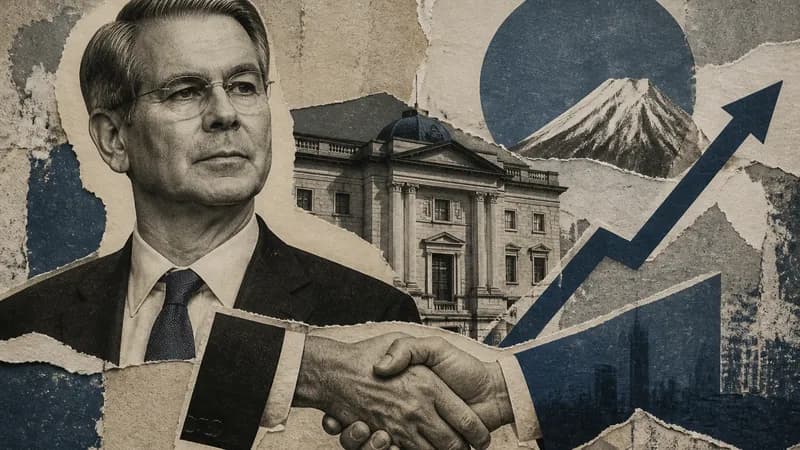
U.S. Treasury Secretary Scott Bessent's jab at Japan's dovish premier may help clear political hurdles for the Bank of Japan (BOJ) to raise interest rates in June, analysts say, though there is uncertainty on whether it can support the yen.
Bessent told Reuters on Tuesday he was confident BOJ Governor Kazuo Ueda would do "what he needs to do" if granted sufficient independence by Japan's government, signalling Washington's desire for further rate hikes by the central bank.
In a post on X after his meeting with Ueda on Tuesday, Bessent said Japan's economic fundamentals were strong and that excess currency volatility was undesirable, suggesting its solid growth justified a higher yen and BOJ rates.
The remarks come ahead of the BOJ's next policy meeting on June 15-16, where markets are pricing in an 80% chance of a hike in its short-term policy rate to 1% from 0.75%.
However, a June rate hike could face some opposition from Prime Minister Sanae Takaichi and her dovish aides, some of whom have voiced opposition to further near-term rate hikes.
Bessent's comments echo his past remarks that suggest yen weakness can be addressed through higher BOJ rates. In October last year, he urged Takaichi to allow the BOJ to hike rates. Two months later, the BOJ raised interest rates to 0.75% from 0.5%.
Bessent likely conveyed his views on the BOJ to Takaichi and Katayama during his visit to Tokyo last week, which solidifies the chance of a June rate hike, said Mari Iwashita, executive rates strategist at Nomura Securities.
"The fact Bessent stopped by in Tokyo, as well as his latest remarks, show Ueda has Washington's full support in raising rates," Iwashita said. "Takaichi may consent to a hike if the BOJ says it would help keep yen falls at bay," she said.
When asked about Bessent's comments, Katayama told a news conference that the government has consistently respected the relationship defined by the BOJ law - which guarantees central bank independence, but also requires the BOJ to work closely with the government on economic policy.
Japan's top government spokesperson Minoru Kihara declined to comment, when asked in a news conference on Wednesday whether Bessent had called for further BOJ rate hikes in his meeting with Takaichi and Katayama last week.
"The government hopes the BOJ works closely with the government and guides appropriate monetary policy to stably, sustainably achieve 2% inflation accompanying wage gains, rather than one led by cost-push factors," he said, when asked for the government's view on whether the BOJ should hike rates in June.
The key would be whether the BOJ can arrange a meeting between Ueda and Takaichi before the governor's closely watched speech on June 3, where he could drop hints on the likelihood of a near-term rate hike, analysts say.
Takaichi and her aides have publicly voiced reservations over a near-term BOJ rate hike, arguing that the central bank should align its policy with government efforts to keep reflating the economy through spending and investment.
The BOJ's meeting in June comes around the time the government compiles a supplementary budget to fund subsidies aimed at cushioning the blow to households from soaring fuel costs caused by the Middle East conflict.
It may also coincide with growing signs of economic strain from the Iran war, which is boosting the cost of living and causing supply disruptions in an economy heavily reliant on fuel imports from the Middle East.
"The premier is said to be cautious about further rate increases, though the administration may nod to a June hike if there was strong pressure from Washington," said a source familiar with government negotiations with the BOJ.
A global bond market rout, driven by investor fears over inflationary risks caused by the conflict, also complicates the BOJ's decision.
Aside from setting its short-term policy rate, the BOJ will also review its bond taper plan running through March next year, and lay out a new plan for fiscal 2027, at the June meeting.