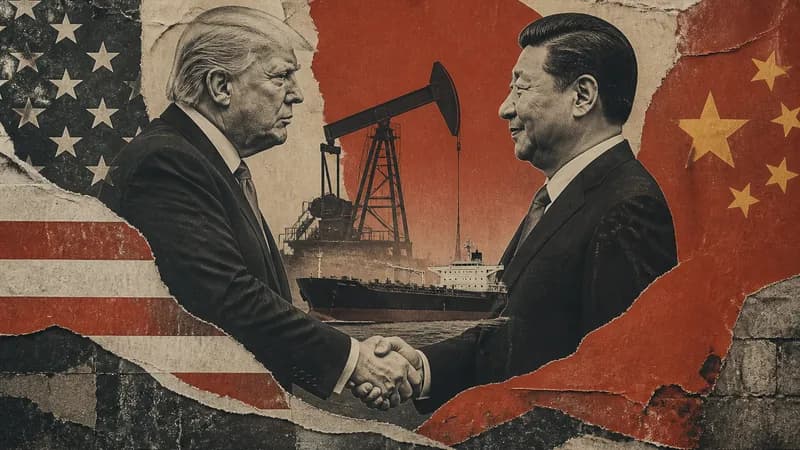
U.S. President Donald Trump said in an interview on Fox News’ Hannity program that China had agreed to buy U.S. oil and energy after an initial round of talks with President Xi Jinping in Beijing.
Trump, in a pre-recorded interview aired on Thursday evening, said China had "agreed they want to buy oil from the United States… they’re going to go to Texas, they’re going to start sending Chinese ships to Texas and to Louisiana and to Alaska."
Trump said that China needed to import oil, citing the country's "insatiable appetite" for energy. The interview was recorded after Trump met China's Xi in Beijing on Thursday.
China buys little oil from the U.S., and is a major importer of Iranian oil, with U.S. government data showing the country imported about 1.4 million barrels per day of Iranian crude in 2025.
Shipping disruptions in the Strait of Hormuz, stemming from the U.S.-Israel war on Iran, stood to potentially disrupt oil flows to China. But reports since March showed some Chinese oil tankers had made it through Hormuz.
Global oil prices rose sharply since the onset of the Iran war, although Trump told Fox News that the increase was not as much as he had initially expected.
Trump said China's Xi also sought an end to the Iran war, and that China did not want Tehran to have a nuclear weapon. He added that Xi had also agreed to not supply Iran with weapons.
Trump called for Iran to accept a peace deal, warning that Washington could easily carry out even more debilitating strikes against the country.
China's foreign ministry said on Friday that Trump and Xi had achieved a "series of new consensus" during Thursday's talks, but did not elaborate on what deals were reached.
Speaking on Fox News' Hannity, Trump said China had also agreed to purchase 200 Boeing jets, and that he would push for the country opening up to payments major Visa.
Trump and Xi leaders are set to hold more talks on Friday, as the U.S. president closes out a three-day visit to China.
Beijing signaled that Taiwan would be at the top of its agenda for the talks, and warned that any mishandling of the situation could even result in conflict.